


Bridging Campus Gaps with a Smart Chatbot & Community Hub
Redefining campus navigation, information access & student engagement at Indiana University Indianapolis

ABOUT
Navigating a university campus is more than just finding buildings, it's about accessing the right information at the right time. Students often face fragmented digital resources, hesitation in large social groups, and confusion about campus services like lost-and-found.
Our project, a Conversational AI Chatbot integrated with a Student Community Platform, tackles these gaps by centralizing campus information, providing quick and reliable answers, and fostering a peer-driven support system.
User Experience Designer
MY ROLE
Research, Product Strategy, Conversational User Interface (CUI) Design, Usability Testing
RESPONSIBILITIES
Figma, FigJam, Sheets, LucidChart, Google Forms, Voiceflow
TOOLS
Dec’ 24 - May'25
DURATION
Geetika P, Saksham R, Sharanya P, Shreya (me)
TEAM
Conversational AI Chatbot, Student Engagement
CATEGORY
CONTEXT
We initially set out to map campus resources like study spaces, printers, and microwaves, aiming to make them easier to find. However, through extensive user research, we discovered a larger issues:
Difficult to Find Campus Resources
Students struggle to locate study spaces, printers, and microwaves when they need them.
Scattered Information
Important campus details are spread across multiple IU websites, making it difficult to get quick answers.
No Clear Processes
No defined steps for common issues like reporting a lost ATM card or requesting building maintenance.
Hesitation to Ask for Help
Students avoid asking simple questions in community groups, worried about judgment.
Research & insights
To uncover pain points we conducted surveys (32 participants) and semi-structured interviews (14 participants) to understand pain points. Key findings from our study include: user research, we discovered a larger issue-
Survey Results
65%
of students spent over 10 minutes searching for a resource online.
55%
relied on peers or social media for event updates because campus websites were hard to navigate.
53%
had been late to class due to poor way finding their first time around.
These insights confirmed that students needed a faster, more approachable way to access information.


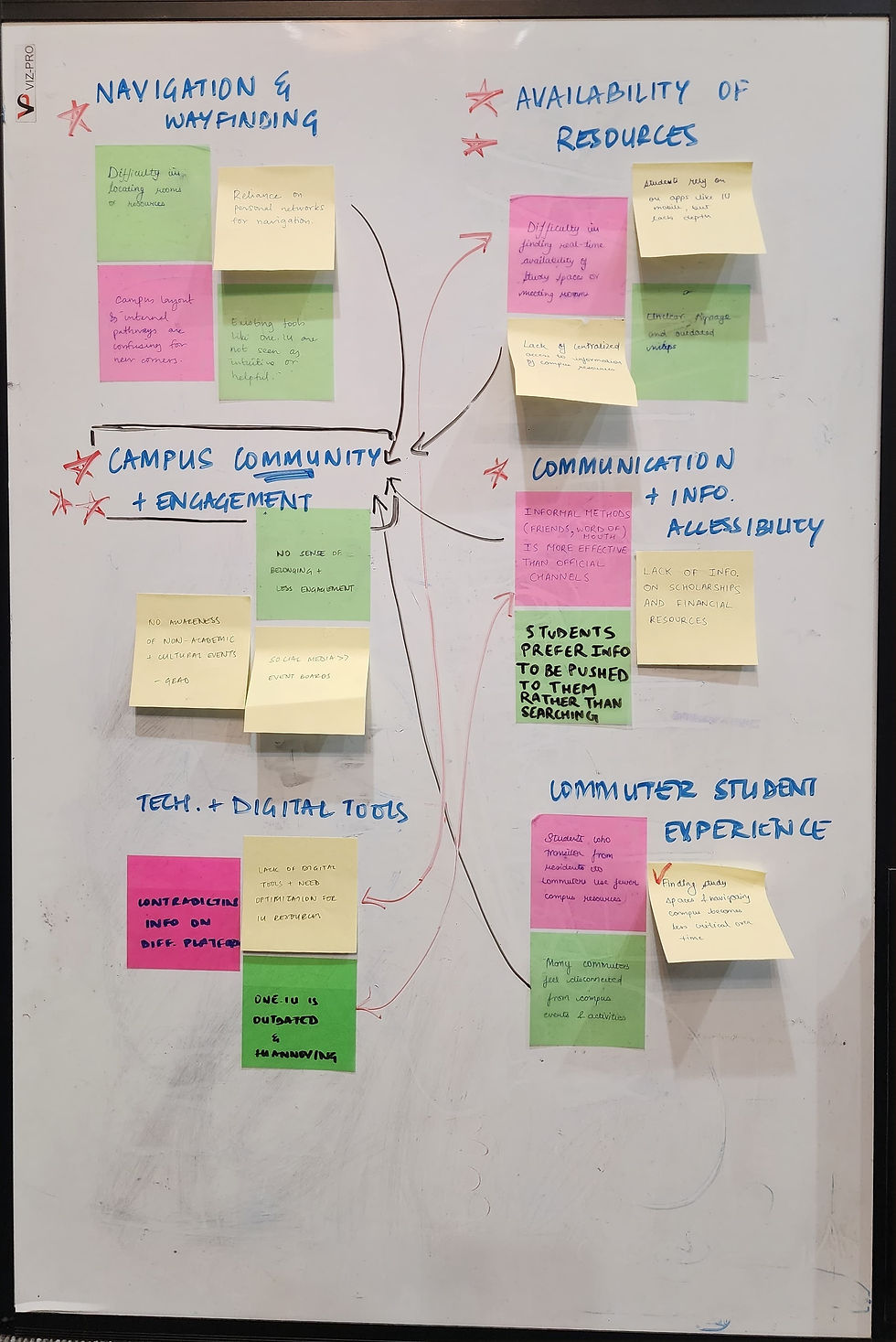


We synthesized research through affinity mapping and collaborative workshops, translating raw student feedback into clear opportunity areas that guided our design direction.
Understanding Our Users
Our research revealed that students face different types of challenges depending on their campus lifestyle and engagement level. To ensure our solution addressed a diverse range of student needs, we identified two key user types followed by problem statement framing:
Maya
The Commuter Student
-
Needs: A quick way to find study spaces & campus resources
-
Pain Points: Feels out of the loop, hard to find study spaces
-
Goal: Stay informed, find resources efficiently, & feel more connected


Alex
The Resident Student
-
Needs: A better way to promote events & reach students
-
Pain Points: Low event turnout, scattered information
-
Goal: Ensure better event visibility, improve student engagement


PROBLEM STATEMENT
How might we create a seamless, student-friendly platform that helps students quickly access campus resources and navigate their environment without feeling lost or disconnected?
ideation & design evolution
Our research revealed that students face different types of challenges depending on their campus lifestyle and engagement level. To ensure our solution addressed a diverse range of student needs, we identified two key user types:
Iteration 1
Chatbot-Only Approach
Our initial chatbot provided quick answers to FAQs like “Where is the nearest printer?” but lacked depth:
-
Helpful but impersonal
-
No support for peer discussion
-
Limited ability to handle complex or social use cases

Iteration 2
Chatbot + Community Hub
To make the experience more engaging and useful, we expanded the chatbot into a student-driven platform:
-
JagBee as a smart conversational gateway
-
JagCommons as a space for peer questions, lost and found, and campus updates
-
Better support for real-world student workflows

Design process
Based on our research insights and early iterations, we translated student needs into a structured design through a series of exploratory and iterative steps. Following is a look at how early ideas evolved into a structured, high-fidelity solution:

Ideation & Brainstorming
We explored initial ideas through whiteboarding and sticky-note exercises to surface assumptions, constraints, and opportunities grounded in student needs.

Information Architecture
We organized campus resources and conversations into a clear, scalable structure that supported both quick answers and deeper exploration.
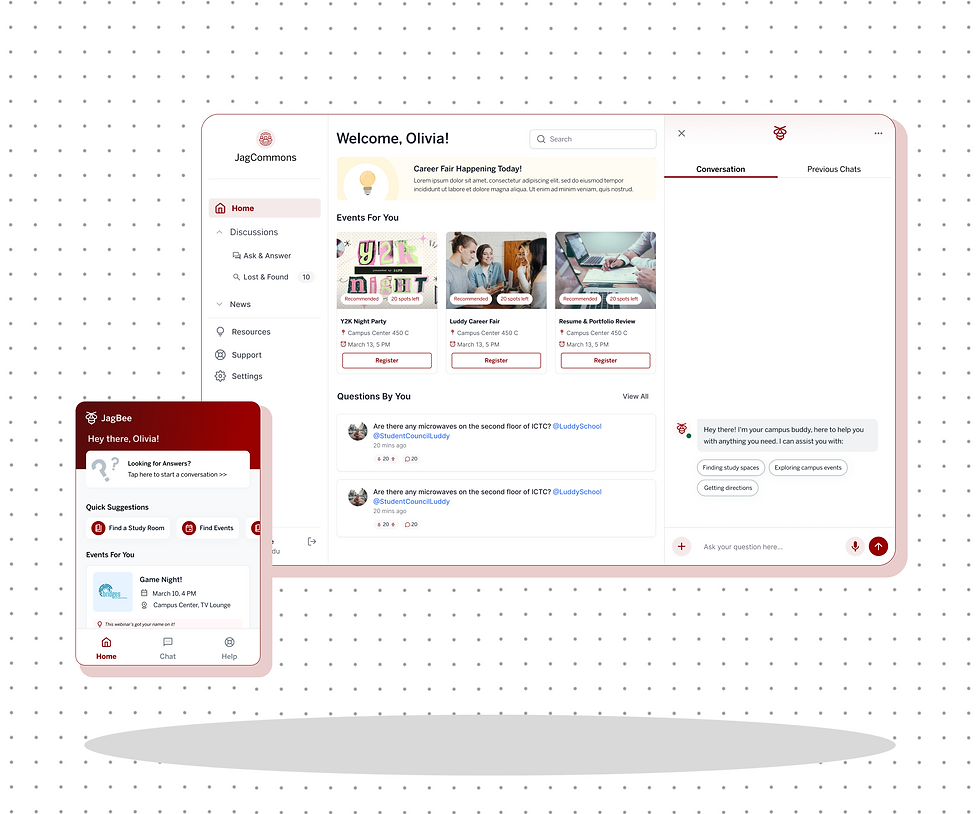
High-Fidelity Preview
Final stages of designs brought together visual identity, conversational patterns, and interaction details to reflect a friendly yet reliable campus experience.
introducing Our Campus Copilots
JagBee is the chatbot for instant campus help. JagCommons is the community that keeps students connected.

Got a campus question? JagBee’s got the answers.


Ask the campus. Get real answers together.

Solution overview
JagBee and JagCommons together create a unified campus experience that helps students quickly find information, navigate resources, and stay connected. JagBee acts as the first point of contact through conversational AI, while JagCommons extends support through peer discussions, lost and found, and campus-wide updates.
See JagCommons in action below ↓
.png)
Discussion Board
A shared space where students ask questions, exchange tips, and help each other in real time.
Lost & Found
A guided flow for reporting and recovering lost items, connected to the right campus locations and peers.
Department & Building Info
Quick access to department details, building information, and campus services through structured navigation.
Usability Testing & Validation
We evaluated JagBee and JagCommons through internal walkthroughs and student-facing usability sessions to assess clarity, usefulness, and ease of navigation. Highlights from testing:
Testing Results
82.2
average System Usability Scale (SUS) score
92%
of participants found the system easy to use
10 of 12
students said they would use it regularly
These results validated the conversational approach and the value of combining quick AI-driven assistance with a community-based support layer.
A Day with Our Campus Copilots
To demonstrate how JagBee and JagCommons support students beyond individual features, we created a scenario-based video showing how the system fits into a typical day on campus. Watch the video below:
We presented our project at the IU Indianapolis Capstone Showcase in May 2025. Here are a few highlights and behind-the-scenes moments.


conclusion & Reflection
JagBee and JagCommons demonstrate how conversational AI and community-driven design can work together to simplify campus life. By centralizing fragmented information and creating space for peer support, the system reduces friction and helps students feel more connected to their campus.
This project strengthened my ability to design at a systems level, balancing information architecture, conversational design, and human-centered interaction while working within institutional constraints.